My DisciplesCommunity Building & Parish Management Request early access

For Catholic parishes

Give your parish office its week back.

Families, ministries, formation, the Mass schedule, the bulletin list and your website, all running off one record. Built for Catholic parishes, not a church CRM wearing a Catholic hat.

In beta. We are taking a handful of parishes now.

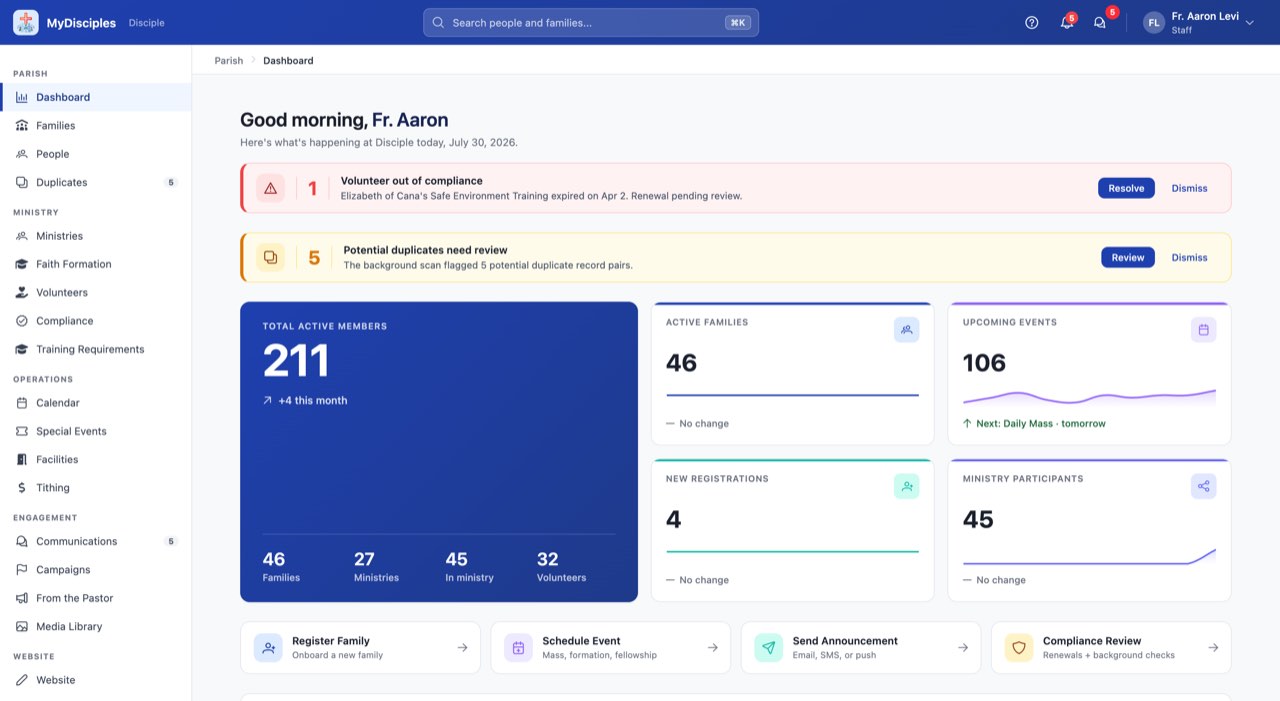
Parish dashboard showing active members, upcoming events, pending approvals and a compliance alert

Why we built it

Most parishes run on six systems and a shared spreadsheet.

One database for households. Another for religious education. A mail tool nobody has the password to. A website a volunteer built in 2014. A signup sheet in the vestibule. Three people are holding all of it together by re-typing the same family into four places, and every one of those places disagrees with the others.

  • 01The record is never current. A family moves, and it is right in one system and wrong in three.
  • 02Nobody can answer simple questions. How many kids aged out of formation this year? Who has a lapsed background check?
  • 03Parishioners have no front door. Every request is a phone call to the office during office hours.
  • 04The pastor is the integration layer. Which is not what he was ordained for.

The record underneath

A household, not a row in a mailing list.

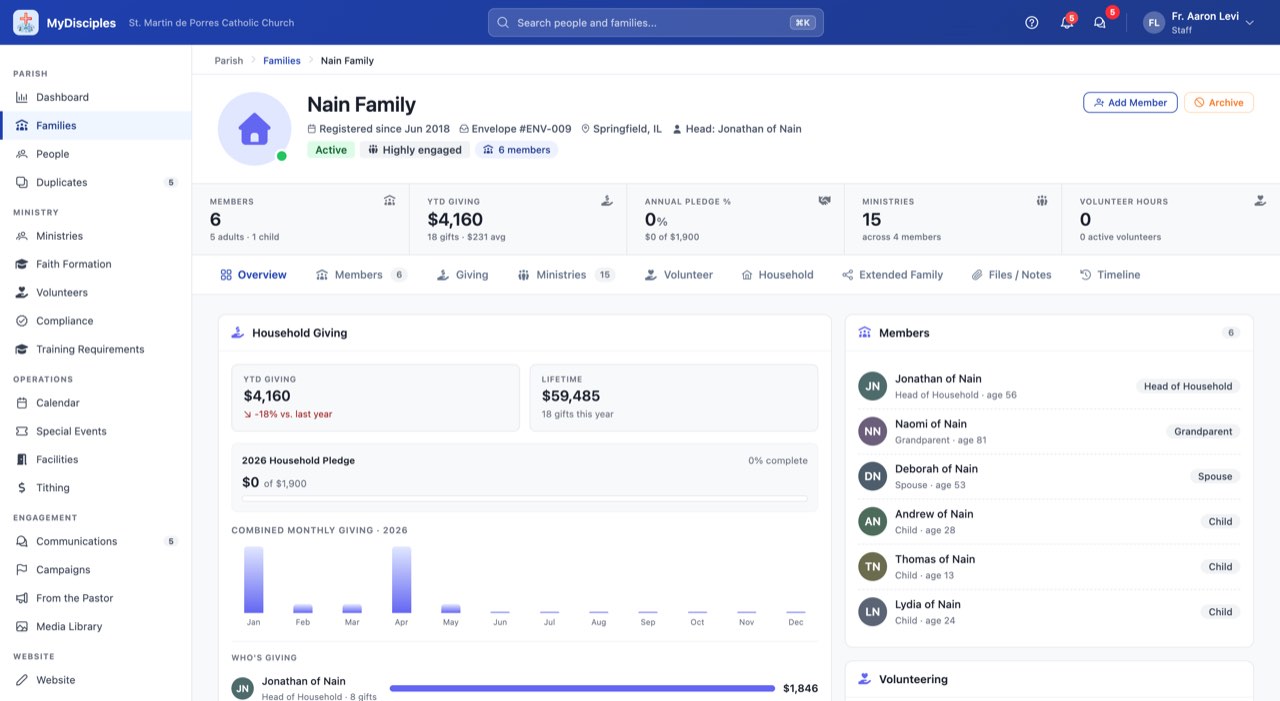
Parishes think in families, so the record does too. Open one household and you have got everybody in it, what they give, what they serve in, what sacraments are on file and what the staff need to remember about them. The grandmother living upstairs is a member of the family, not a duplicate contact you clean up later.

Family profile for a six-member household showing members and roles, household giving and ministry involvement
A three-generation household: head, spouse, three children and a grandparent.
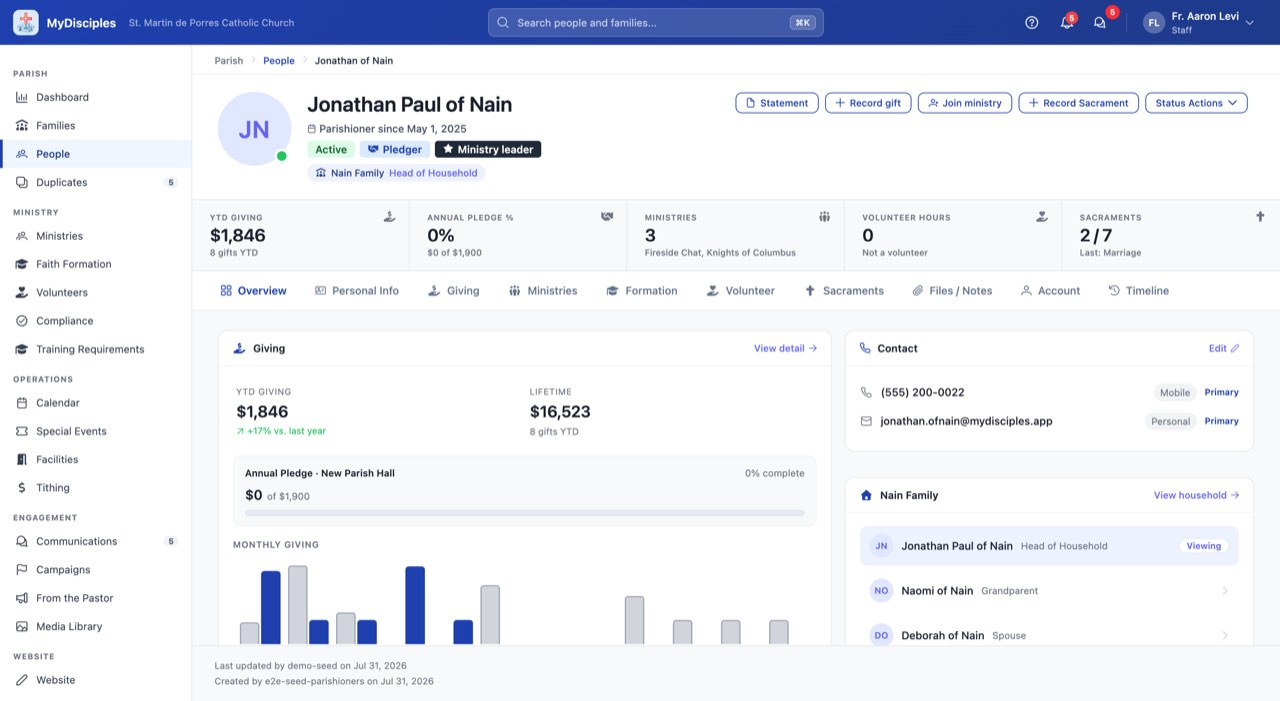
Parishioner profile showing pledge status, ministries, sacraments and giving history

And a person underneath that

Every parishioner has their own record: what they have given, which ministries they lead or serve in, which sacraments are on file, what formation they have completed, and every change anyone has made.

Duplicates caught before you notice them

A background scan compares names, addresses and households and pulls out the pairs worth a second look. Then AI reads each pair and tells you what it is actually seeing: same street, a married name, a transposed birthday, a nickname nobody standardized. It scores how confident it is and recommends merge, keep separate, or take a closer look.

A person still makes the call, and the merge is a real merge rather than a delete. Twenty years of imports stop compounding, and the list stays clean enough that your staff actually trust it.

Heartbeat

Clean up your whole roster in a weekend.

Be honest: nobody knows how many of those families still live in the state. People move, marry, bury a parent and drift, and none of it reaches the office. So the list rots, quietly, until the staff stop trusting it and go back to the one they keep in a drawer.

Heartbeat ends that in three steps, and not one of them is a phone tree.

  • 01Press the button. Every parishioner gets their own private link. Export them and blast it from Flocknote or Mailchimp, the tool you already pay for. Your list, your send.
  • 02They tap once. Still here. Moved away. Just a donor. That is the whole ask, and it takes them four seconds on a phone in the parking lot.
  • 03Your database fixes itself. Still here opens their household so they correct their own address and can walk out with a portal login. Moved away retires the household. Just a donor reclassifies them and keeps every dollar of history.

Watch the answers land live, then call the eleven people who never replied instead of all six hundred. Every record gets stamped with the day you last heard from them, so next spring you run it again and your roster never drifts for long.

What it does

Twelve jobs. One record. Zero exports.

Register a family once and they are already in formation, on the roster, on the mailing list and in the directory. No CSV, no import wizard, no Tuesday afternoon spent reconciling two systems that were supposed to talk to each other.

Families & People

Households, not contacts. Sacramental records, relationships that cross households, and AI-assisted duplicate detection with a real merge.

Ministries

Two-level groups with leaders and co-leaders, rosters, prerequisites, and join requests that route to the right person.

Faith Formation

Programs, sessions, catechists, enrollment and attendance. OCIA, sacramental prep and K-12 in one place.

Calendar

Mass times, liturgical season, ministry meetings and formation sessions in one view your staff and parishioners both see.

Facilities

Rooms and grounds with booking requests, automatic conflict checking, and an approval trail.

Media

1 TB per parish. Albums, a picker wired into every editor, and a quota you can actually see.

Workflows

Registration triage, volunteer roles, substitutions and facility requests, each with who approved what and when.

Reports

Demographics, directories, new members. Run it, save it, or schedule it to arrive in your inbox.

Communications

Email, SMS and push from one composer, with per-category subscriptions so people can opt out of one thing, not everything.

Parish Website

A full public site on your own domain, edited by staff. Pages, news, sacrament pages, bulletins and Mass times, no developer in the loop.

Campaigns & Forms

Build a form, run a stewardship campaign, collect and review responses without a third-party form tool.

Special Events

Ticketed and paid registration with tiers, capacity and custom questions. Festivals, retreats, men's conferences, and more!

Multi Language

If half your parish worships in Spanish, an English-only app is not worth installing. So the portal, the apps and the public site were built multi-language from the ground up rather than having a translation layer bolted on later. Spanish lands shortly after launch, and the next language after it is not a rewrite.

Coming soon after launch
Giving in the app

Import your existing giving data at launch and it drives statements, household and parishioner giving screens and every report. Taking the donation in the app comes next.

Coming soon after launch
Volunteer Scheduling

Volunteer records, roles and background-check compliance are here now. Building the schedule, filling shifts and covering substitutions is next.

Coming soon after launch
Diocesan Tools

Roll-up reporting for the chancery, diocesan compliance tracking, sacramental reporting and central policy push-down. The multi-parish foundation is already built.

Coming soon after launch
Built Catholic

It knows what a vigil Mass is.

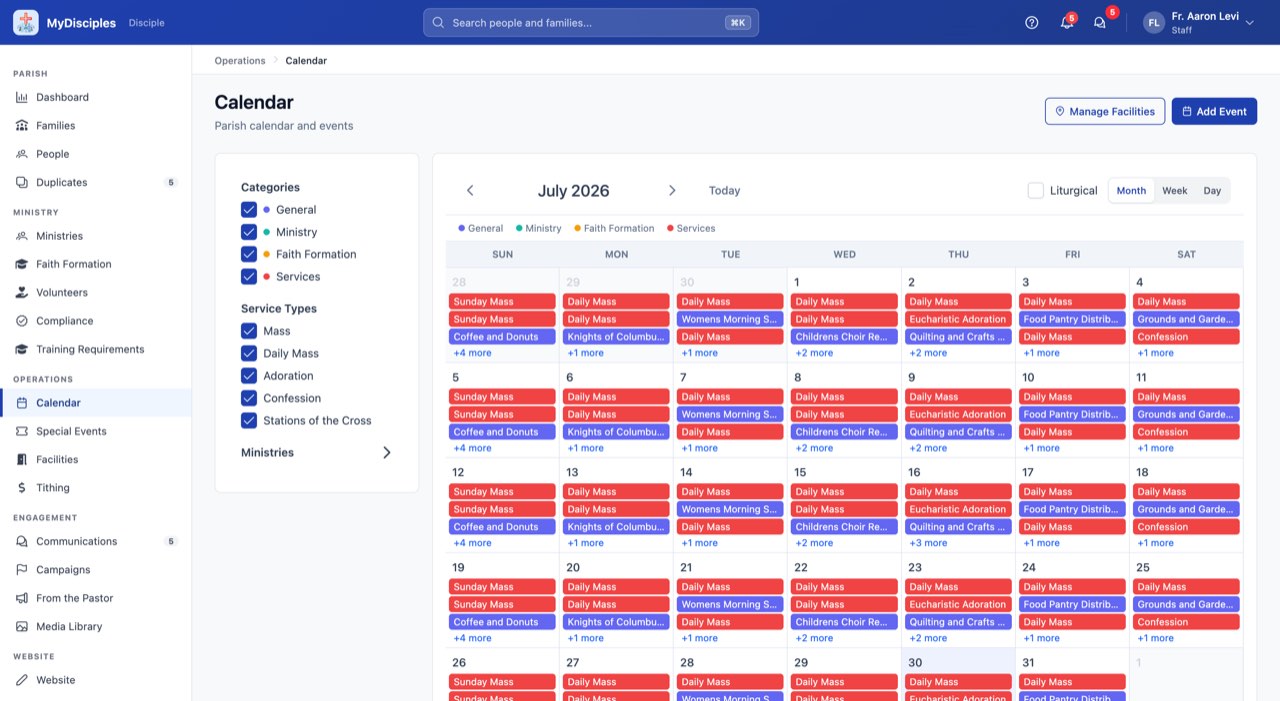
Seasons and colors it already knows. Daily readings pulled straight from the lectionary, every morning, without anyone retyping them. Mass, confession and adoration as real service types, not blank "events" your secretary has to name and re-name every single week.

Parish calendar for a month showing Sunday Masses, daily Mass, confession, adoration and ministry meetings
One month of a real parish schedule. Services, ministry and formation filter independently.

Communications

Know whether the bulletin email actually landed.

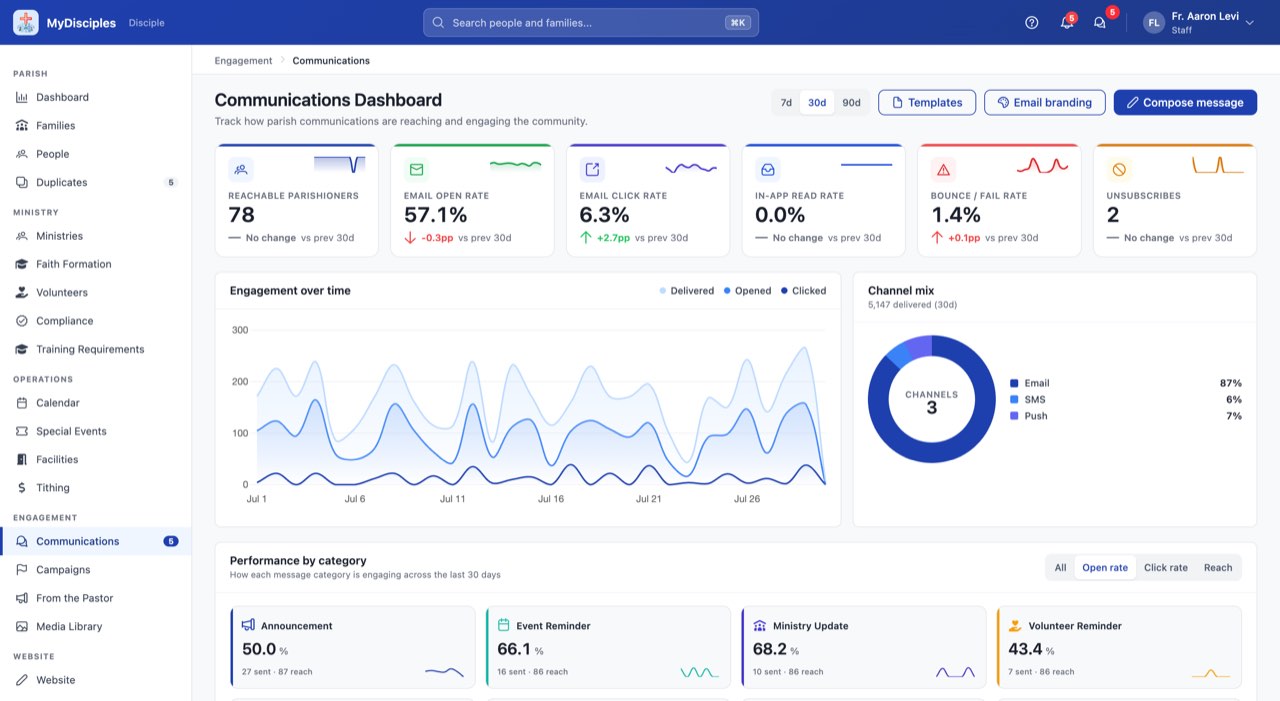
Send to a ministry, a formation year, the whole parish or one family, then watch it land. Delivered, opened, clicked, unsubscribed, broken out by category. "Did anyone actually read it?" stops being a shrug at the staff meeting.

Per-category subscriptions mean a parishioner can mute volunteer reminders without losing the pastor's letter. Which is the difference between an unsubscribe and a lost parishioner.

Communications dashboard with open rate, click rate, bounce rate and a 30-day engagement chart

For parishioners

The half your parishioners actually touch.

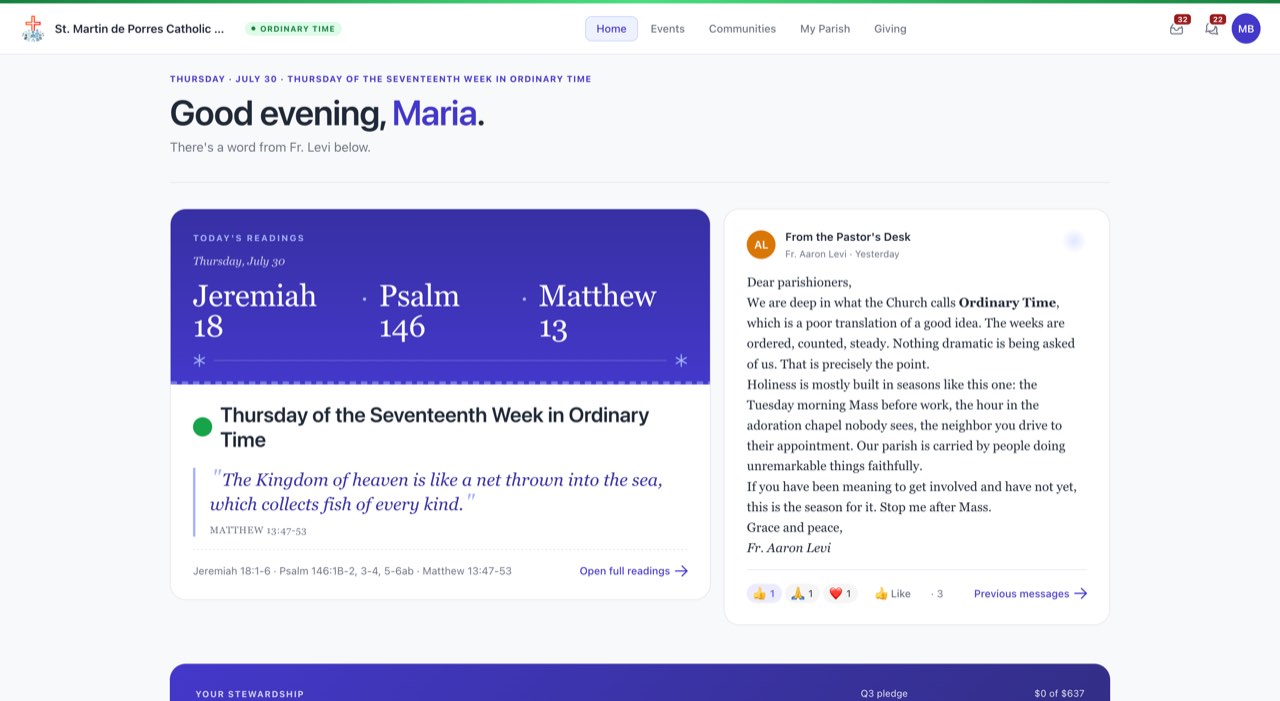
A web portal plus iOS and Android. Today's readings, Mass times, their ministries, the directory, event RSVPs, their giving history and a word from the pastor. All the things they used to call the office about, in their pocket.

Parishioner portal home page showing today's readings and a message from the pastor
Portal home. Readings come from the lectionary, not a placeholder.

Self-service, so the office phone stops ringing

Parishioners update their own address, register for events, join a ministry, manage what they hear from you, and see their own giving history. Every change lands on the same record the staff sees.

Built multi-languageComing soon after launch

If half your parish worships in Spanish, an English-only app is not worth installing. So the portal, the apps and the public site were built multi-language from the ground up rather than having a translation layer bolted on later. Spanish lands at launch, and the next language after it is not a rewrite.

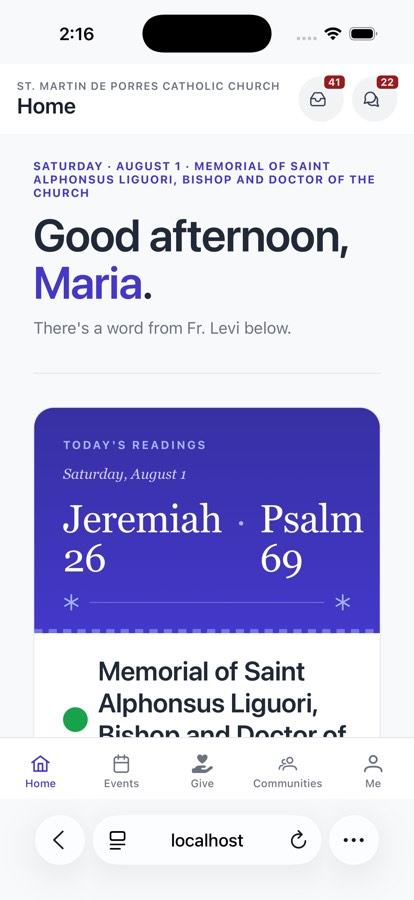
Parish portal on an iPhone showing today's readings and a greeting
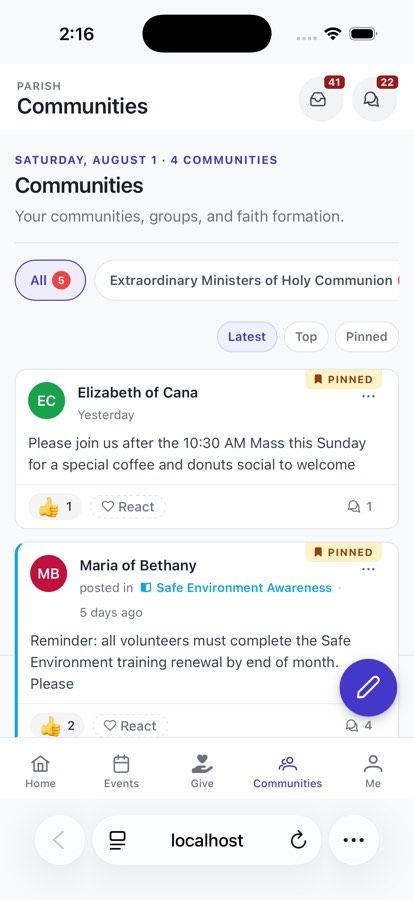
Parish portal on an iPhone showing pinned community posts with reactions and replies

That is the portal on a phone, not a cut-down version of it. Nothing to install, nothing to update, and the same record the office is looking at. Native iOS and Android apps are available too, for the people who want notifications and a home-screen icon.

Communities

Take your ministries back from Facebook.

Your choir is on GroupMe. Your youth group is in a Facebook group somebody's cousin admins. Your councils run on reply-all chains that drop half the recipients. None of it belongs to the parish, and when a leader steps down it walks out the door with them.

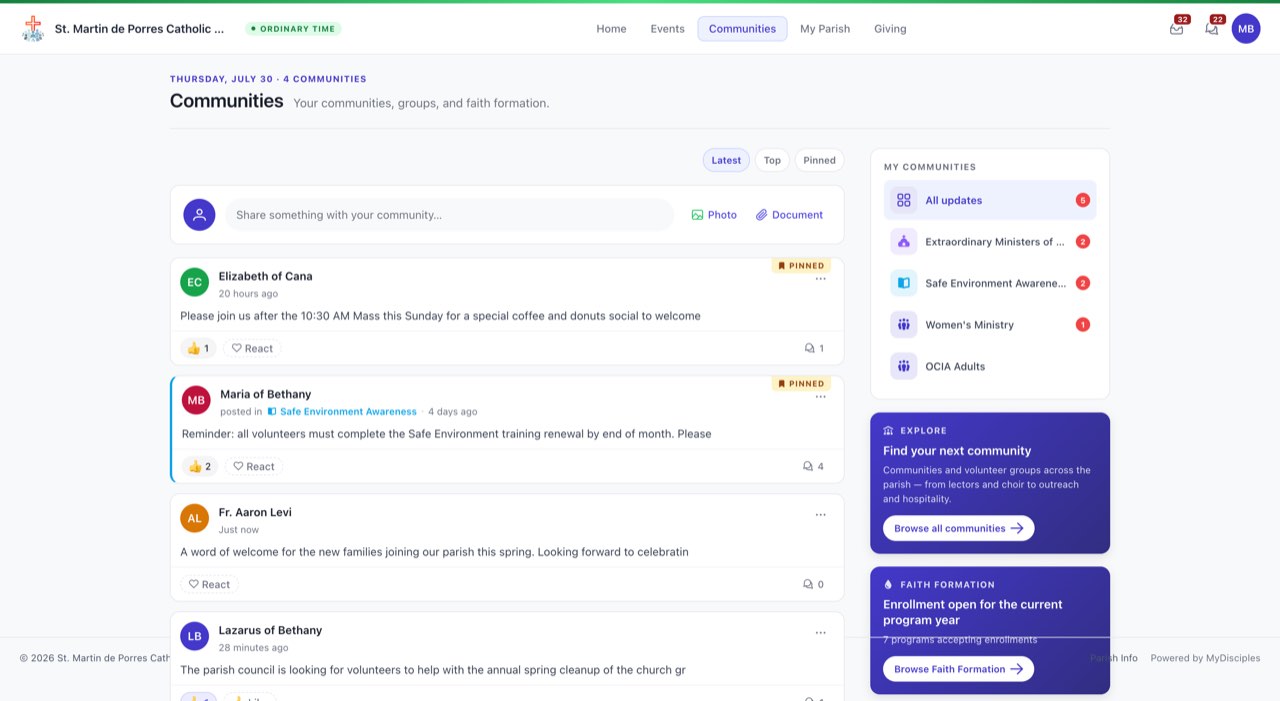
Parishioner community feed with pinned posts, reactions and comments across parish groups
One feed, filtered to the groups a person actually belongs to.

A space per ministry, automatically

Every ministry, formation program and volunteer group gets its own channel, with membership drawn from the roster. Join the choir and you are in the choir's space. Leave it and you are out. Nobody maintains an invite list.

Announcements that reach everyone

A parish-wide channel for the things everybody needs, and staff can pin a post so it stays at the top rather than scrolling away by Tuesday.

Posts, replies, photos and files

Leaders post updates, attach the schedule or the sign-up sheet, and people react and reply. The permission slip lives with the group that needs it instead of in one volunteer's inbox.

It stays yours

The conversation happens on the parish's system, under the parish's moderation, tied to the parish's directory. A leader stepping down hands over a role, not a password.

Your website

Keep the site you have. Or finally replace it.

Either way you win, because the important part is not who hosts the pages. It is that the buttons on them write straight into the parish record instead of into somebody's email.

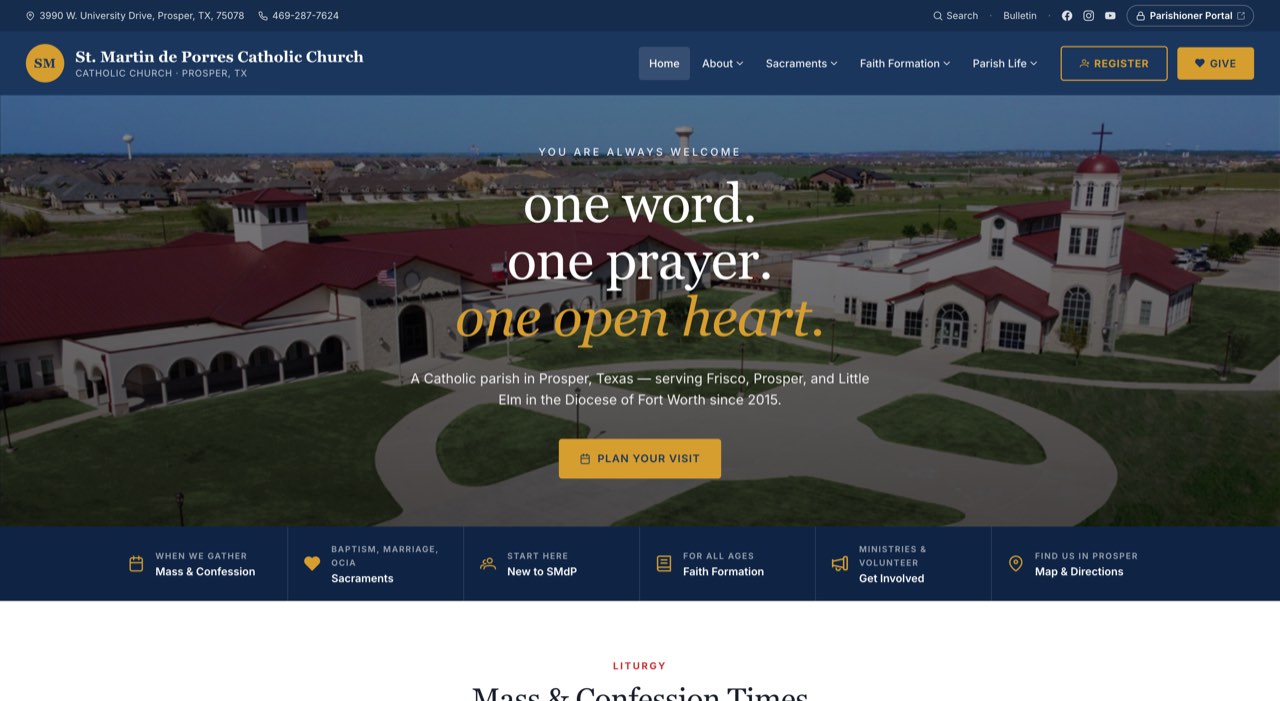
Public parish website home page with hero, Mass and confession links, and a parishioner portal link
A real parish site on its own domain, edited by staff, no developer in the loop.

Bring your own site

Love your website? Keep it. Registration, event sign-ups, forms and the parishioner portal all live at their own links. Drop them into the nav of whatever you already run and nothing else has to change. No migration, no redesign, no arguing with the volunteer who built it.

Or hand us the whole thing

Your domain, your colors, your photos, and a staff member who can change the Mass times on a Tuesday without filing a ticket. Sacrament pages, faith formation, bulletins, news and the parish directory come built, because we already know what a parish site needs on it.

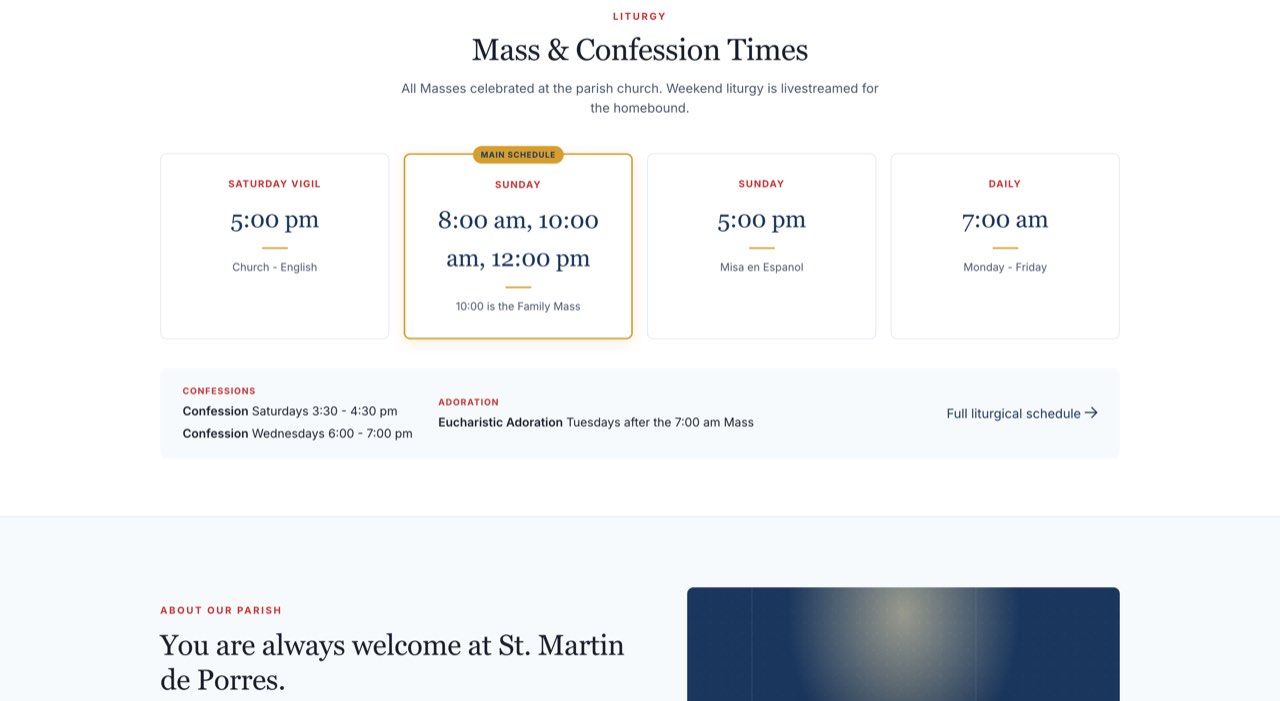
Mass and confession times section of the public parish website

Here is the part that matters. A family that registers on the site is a household in your database before they reach the parking lot. A contact form lands in a staff inbox, not a Gmail account nobody has checked since 2019. Nothing gets re-typed, because there is nowhere to re-type it to.

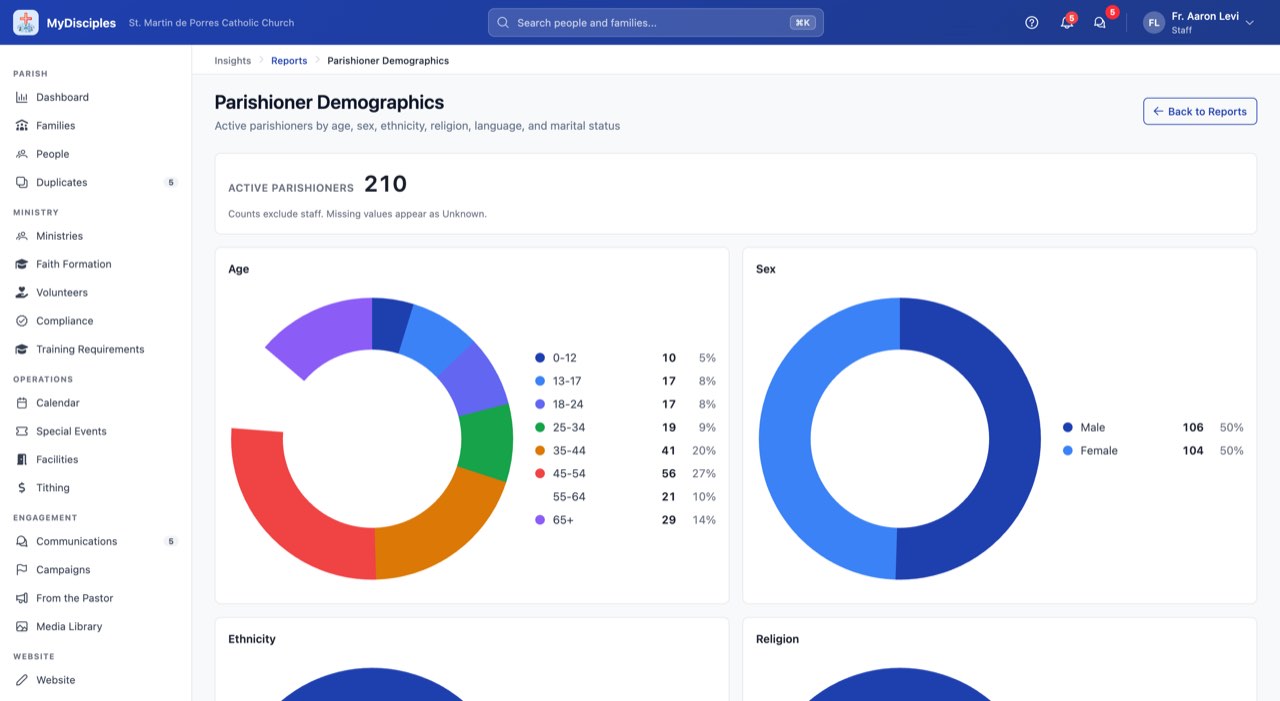
Parishioner demographics report with age, sex, ethnicity and religion breakdowns

Reports

Answer the chancery without a weekend of spreadsheets.

Demographics, directories, new-member reports and ministry participation, built from the live record. Save the ones you run every month, schedule the ones somebody else asks for.

For dioceses

The foundation is already poured.

What is already true is the hard part. My Disciples was not built for one parish and then stretched later. Every record carries its parish and isolation is enforced in the data layer rather than screen by screen, so parishes never leak into each other. Standing up a new parish is a provisioning step, not a migration project.

Built into the platform

  • Per-parish data isolation enforced at the database layer
  • New parishes provisioned from one console
  • Per-parish domains, branding and public website
  • Users and roles managed across parishes
  • Per-parish storage quotas and usage

If your diocese needs something in the right-hand column by a date, say so during early access. We will tell you honestly whether we can hit it, which is worth more to you than a yes.

Who we are

We built this for our own parish first.

Ribb Technologies is a small company started and run by a Catholic couple, both software developers. We offered to help our growing home parish with their software needs, and saw the many struggles they had integrating so many different systems.

Through prayer we discerned that we would use our talents to build not just a parishioner management application, but one that would build stronger communities within our parish and strengthen the Body of Christ.

Ribb Technologies

Questions

The ones parishes actually ask.

Can we get our data out?

Yes. It is your parish's data and export is not a retention lever. Ask us about the specific formats you need before you sign anything.

What happens to our data if we leave?

You take it with you. The written terms covering ownership, export and retention are being finalized and will be linked here before general availability.

Do you replace our parish website?

You can use it as your website, with your own domain and branding, edited by staff. Mass times and events come straight off the parish calendar, so the site stops going stale. You can also keep the site you have and use everything else.

Do parishioners need an app?

No. Everything a parishioner can do in the app they can do in a browser. The apps are for the ones who want notifications and a home-screen icon.

Does it handle Spanish?

Not yet, and we would rather say so than let you find out in month two. The portal, the mobile apps and the public site were built multi-language from the start, so this is a matter of finishing and testing the translations rather than re-architecting anything. Spanish is scheduled for launch. If your parish is majority Spanish-speaking, tell us during early access and we will tell you honestly where it stands.

Who is behind it?

A Catholic couple who both write software and started by helping their own parish with it. The short version is above. Company details, security posture and compliance documentation will be linked from this page before general availability.

Early access

Get in before it sets.

My Disciples is live, in use, and not finished. That is the offer. We are taking a handful of parishes now, and what those parishes ask for is what gets built next.

Come in later and you get a mature product shaped around somebody else's parish. Come in now and it gets shaped around yours.

0/600
Cloudflare Turnstile mounts here. It cannot load in this preview because the page is blocked from fetching scripts off-domain.

No newsletter, no drip sequence. A real person replies.